


Imagine a world where software alternatives to products built by major technology companies can be developed by an individual developer with the help of AI.
Creative applications, image editors, video production tools, presentation software, spreadsheets, and productivity tools that once required substantial engineering resources are now becoming targets for much more ambitious development projects.
That is what makes the progress of Claude AI and the open-source ArtCraft project so interesting.
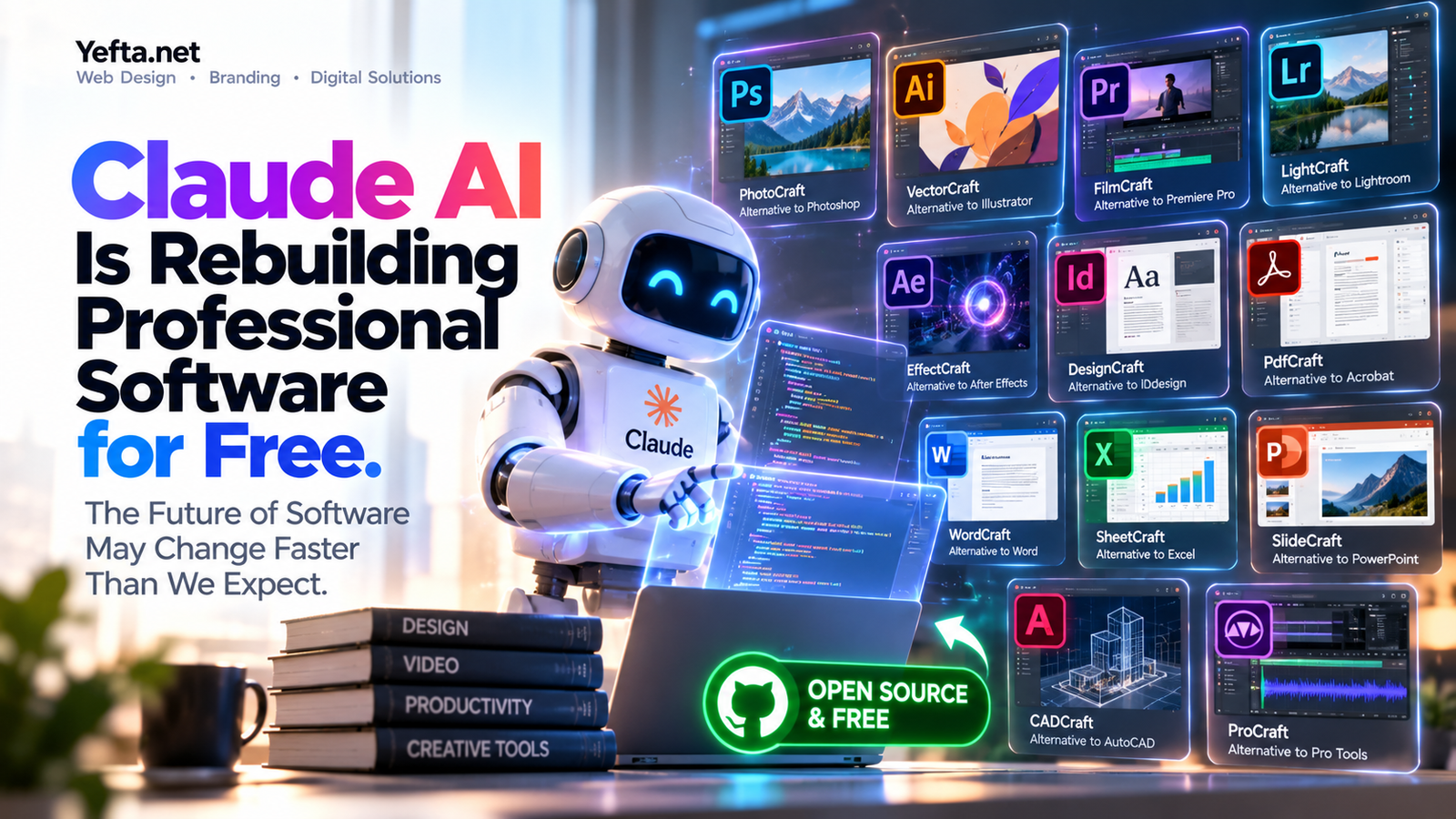
From late September through October 2026, ArtCraft introduced a collection of applications designed as alternatives to popular software, including Adobe Photoshop, Illustrator, Premiere Pro, Lightroom, After Effects, InDesign, and Acrobat. Related projects subsequently expanded into software inspired by Microsoft Word, Excel, PowerPoint, AutoCAD, and Pro Tools.
According to available reports, developer Brandon Thomas used Claude Opus 5.5 to assist in building these applications with the Rust programming language. The projects were published as open-source software, allowing people to study and develop the code under the applicable licenses.
Sources: ArtCraft on GitHub and TechRadar's report.
The most interesting part is not simply that these applications are available for free.
The bigger story is how the process of building software is changing.
One AI Model, A World of New Possibilities
For decades, building professional software required a combination of programming expertise, interface design, system architecture, testing, and extensive development time.
Large companies have the resources to build and maintain complex products. Independent developers, meanwhile, often have to choose projects carefully because of limited time, personnel, and budgets.
AI coding assistants are beginning to change that equation.
With Claude's assistance, developers can accelerate code generation, establish application structures, implement features, debug problems, and iterate on projects at a scale that was previously much harder for small teams to achieve.
However, it is important to understand the context: Claude is not replacing the entire engineering process. Developers still define the project's direction, manage implementation, evaluate the results, and resolve technical problems.
ArtCraft demonstrates how collaboration between human expertise and AI can produce projects with ambitious scope.
And this may only be the beginning.
This Is Not Simply About Copying Existing Software
There is an important technical distinction to understand.
ArtCraft describes its approach as clean-room reimplementation: independently building software that reproduces certain behaviors and workflows rather than simply copying the original product's proprietary source code.
This means we should not conclude that Claude stole or copied Adobe's internal code or the source code of other companies.
What the project demonstrates is the potential of AI-assisted development to help create software alternatives with similar goals and functionality.
Of course, similarities in functionality, interface design, and software behavior can raise separate legal questions. An independent implementation does not automatically guarantee that every aspect of a project is free from legal risk.
From a technology perspective, however, the experiment remains significant. Developers now have new ways to explore products that were previously extremely expensive or difficult to build.
What Happens When Other AI Models Catch Up?
This is where I see the potential for a much larger transformation.
We are currently witnessing AI systems such as Claude being used to help build complex applications. But Claude is not the only AI system advancing in software development.
Different models and coding assistants are competing to improve their ability to understand codebases, generate code, debug problems, use tools, and complete complex development tasks.
Imagine if these capabilities continue to improve.
What happens when AI becomes better at understanding large software architectures?
What if AI can test its own code more effectively, identify problems earlier, and improve implementations through repeated iterations?
What if developers can combine several AI models, each with different strengths, to design, build, test, and optimize a product?
We do not need to assume that every one of these possibilities has already become reality to recognize the direction of change.
If the barriers to software development continue to fall, more people may be able to build applications that were previously beyond their reach.
And when one capability advances rapidly, competition from other AI models could accelerate the transformation even further.
Should Major Software Companies Be Worried?
Established software companies certainly have reasons to pay attention. But that does not mean their products will immediately be replaced.
Professional software is much more than a collection of menus and buttons.
Adobe, for example, has an ecosystem built through years of development: file-format support, color management, plugins, integrations, stability, performance, and professional workflows.
All of these require continuous engineering effort.
ArtCraft applications are still in early development and have limitations in certain features, compatibility, and professional readiness. It would therefore be premature to consider them complete replacements for Adobe Creative Cloud or similar software.
However, established companies do not need to lose their entire market to feel the impact of technological change.
Lower-cost alternatives can attract specific users. Specialized software can solve problems that were previously uneconomical to address. Open-source products can also give users more choices.
Even when an alternative lacks the full feature set of an established product, its existence can change market expectations around pricing, accessibility, and the pace of innovation.
What Does This Mean for Developers, Designers, and Business Owners?
The implications extend across several industries.
For developers: AI can help accelerate prototyping, internal applications, API integrations, and specialized software development. The ability to evaluate code, understand architecture, and maintain security will remain important.
For designers: more people may gain access to creative tools. Conceptual thinking, art direction, audience understanding, and the quality of design decisions can become important differentiators.
For business owners: ideas that were previously too expensive to pursue may become more practical to explore. AI can help build prototypes and test concepts before businesses commit greater resources.
For freelancers and small teams: the ability to develop specialized solutions can create new opportunities, particularly when existing products do not meet a client's needs or are too complex to purchase as ready-made services.
However, all these opportunities still require careful evaluation. Software that can be built faster is not necessarily more secure, more stable, or cheaper to maintain over the long term.
The Biggest Changes May Still Be Ahead
In my view, the most interesting part of this development is not the seven applications designed to emulate Adobe products.
What matters more is what could happen as AI coding capabilities mature.
Today, we are discussing alternatives to familiar applications. Tomorrow, developers may use AI to build entirely new tools, combine functions that previously existed in separate products, or create highly specialized software for particular industries.
We may also see changes in software business models.
If a business can build an internal tool tailored to its needs, will it still need to pay for multiple services containing features it never uses?
If independent developers can create useful products with lower initial costs, how many new ideas might emerge?
And if these capabilities become available to more people, how will software competition change?
Nobody can answer all these questions with certainty today. Technological progress, computing costs, model limitations, security, regulation, and user needs will all influence the outcome.
But one point deserves attention: the pace of change can increase when the ability to build something becomes more accessible.
Conclusion: Prepare for a Faster-Changing Future
The progress of Claude AI and ArtCraft shows that AI is not only helping people use software. It is also beginning to help them build alternatives to complex software products.
We still need to see how these projects develop, whether their quality can meet professional standards, and whether their business models can remain sustainable.
Nevertheless, the technological shift is already worth paying attention to.
If one experienced developer can use AI to explore multiple complex applications, what might happen as AI models become more capable, development tools mature, and more developers learn how to use them effectively?
We may see more new products, more alternatives, more experimentation, and more dynamic competition.
That does not mean all paid software will disappear or that every engineering task will become easy. But the boundaries of what individuals and small teams can build are changing.
Today, we are watching AI help rebuild existing software. Tomorrow, AI may help create entirely new kinds of software we have not yet imagined.
And that transformation could arrive much faster than we expect.
At Yefta.net, I see this development as a reminder that continuous learning, experimentation, and adaptation are becoming increasingly important in the digital world.
The future will not only be about who owns the best software. It will also be about who can understand emerging technologies and turn them into genuinely useful solutions.
Frequently Asked Questions
Is Claude AI really creating free alternatives to Adobe software?
Claude has been used to assist with ArtCraft, a collection of open-source projects that emulate workflows from several Adobe applications. These applications still have limitations and are not complete replacements for professional use.
Did Claude copy Adobe's source code?
There is insufficient evidence to conclude that Adobe's proprietary source code was copied. ArtCraft describes its approach as clean-room reimplementation, involving independent development. That claim does not automatically establish that every aspect of the project is free from legal concerns.
Will AI-built software replace paid software?
Not necessarily. AI may accelerate the creation of alternatives and increase competition, but professional software also requires stability, security, compatibility, support, and long-term maintenance.
Will developers still be needed as AI becomes more capable?
Yes, although their tasks and workflows may change. Understanding requirements, designing architectures, evaluating quality, ensuring security, and choosing appropriate solutions remain important skills.
References
- ArtCraft — GitHub
- TechRadar — One dev is recreating 7 Adobe apps in Rust for free
- Tom's Hardware — Open-source alternatives to Microsoft Office built with Claude
- Creative Bloq — Testing AI-coded Adobe alternatives
Project status and application capabilities may change as technology evolves. This article covers developments reported in October 2026.

Web developer and digital designer with 12+ years of experience building WordPress websites, brand identities and campaigns for businesses in Indonesia, New Zealand, Australia and beyond. More about me
Planning a new website or a redesign? Explore my services or estimate your project in minutes.