


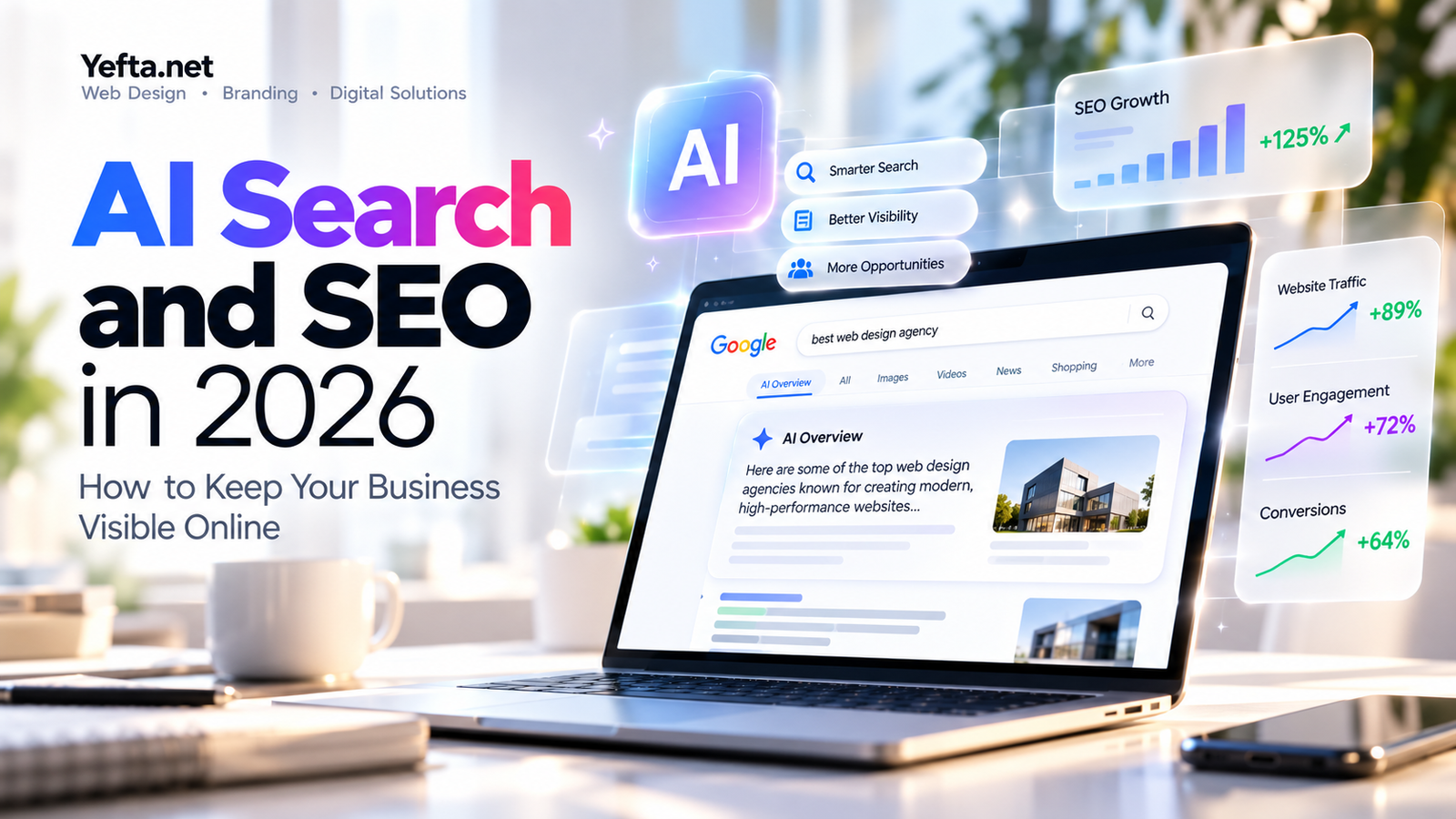
Search engine optimization is changing. In 2026, businesses need to think beyond traditional Google rankings and consider how their websites, expertise, and content appear across AI-powered search experiences.
Tools such as Google AI Overviews, AI Mode, and conversational AI assistants are changing how people discover information, compare solutions, and research businesses.
For business owners, this creates an important question: How can your website remain visible when people increasingly use AI to find answers?
The answer is not to abandon traditional SEO. Instead, businesses should build a stronger SEO foundation while making their content more useful, trustworthy, and easy to understand.
1. Understand How AI Search Is Changing SEO
Traditional search often directs users to a list of website links. AI-powered search can also generate summaries, combine information from multiple sources, and help users explore a topic through follow-up questions.
This changes the way businesses should approach online visibility.
Ranking in search results still matters, but it is also worth understanding whether your content is being discovered, referenced, or cited in relevant AI-generated answers.
There is no guaranteed formula for appearing in AI answers. However, publishing clear, useful, well-supported content gives search systems and readers a better basis for understanding your expertise.
What businesses should do:
Answer specific customer questions directly.
Explain complex topics using clear language.
Support important claims with reliable sources.
Organise articles with descriptive headings and logical sections.
Keep essential business information accurate and consistent.
2. Create Helpful Content Instead of Publishing More Content
AI tools make it easier to produce articles, product descriptions, and social media posts. However, publishing more content does not automatically lead to better rankings.
Content that simply repeats information already available elsewhere offers limited value.
A stronger approach is to publish material that demonstrates real understanding of your customers, products, services, and industry.
For example, a web design business could publish:
A practical guide to choosing the right website platform.
A breakdown of website development costs and the factors that affect pricing.
A case study explaining a design challenge and its solution.
A comparison of different website approaches for small businesses.
A checklist for improving website performance and user experience.
These topics help readers make decisions while demonstrating your practical expertise.
Google's guidance emphasises helpful, reliable, people-first content rather than material created primarily to manipulate search rankings.
3. Build Trust Through Experience and Evidence
Trust matters when people evaluate businesses online.
A website should do more than make claims about expertise. It should provide evidence that helps potential customers assess your credibility.
Consider including:
Detailed portfolio projects and case studies.
Clear descriptions of your services and process.
An author profile with relevant professional experience.
Genuine client testimonials, where available.
References to reliable sources for factual claims.
Updated contact information and business details.
For a digital agency or freelance professional, a well-explained project case study can be more persuasive than a page filled with generic marketing statements.
Show the problem, your approach, the decisions you made, and the outcome. Where measurable results are available, include them accurately and explain how they were measured.
4. Improve Website Performance and User Experience
Search visibility is only part of the equation. Once visitors arrive, your website needs to help them find information and take the next step.
A slow, confusing, or difficult-to-use website can undermine the value of your marketing efforts.
Prioritise these areas:
Mobile usability: Make sure content, navigation, forms, and calls to action work well on smaller screens.
Loading performance: Optimise images, review unnecessary scripts, and choose suitable hosting.
Clear navigation: Organise pages so visitors can understand your services and find relevant information quickly.
Accessibility: Use readable text, sufficient contrast, descriptive links, and appropriate image alt text.
Conversion paths: Give visitors clear next steps, such as requesting a quote, booking a consultation, or viewing relevant projects.
Good user experience helps people use your website effectively and supports your broader business goals.
5. Measure SEO Beyond Rankings Alone
A keyword ranking can be useful, but it does not tell the whole story.
Businesses should evaluate whether their SEO activity is attracting relevant visitors and contributing to meaningful outcomes.
Track metrics such as:
Organic search impressions and clicks.
Search queries that bring visitors to your website.
Engagement with important landing pages.
Enquiries, leads, and completed purchases.
Conversions from organic traffic.
Referral traffic from AI tools, where available and measurable.
Google Search Console can help you understand how your website performs in Google Search. Analytics tools can provide additional context about what visitors do after arriving.
As AI-powered search evolves, reporting capabilities and attribution methods may change. Treat new visibility metrics as useful evidence, not as a replacement for business outcomes.
6. A Practical SEO Action Plan for 2026
You do not need to rebuild your entire website to get started. Begin with a focused improvement plan.
Step 1: Audit your existing content.
Identify pages that attract relevant visitors, pages that need updating, and important questions your website does not yet answer.
Step 2: Improve your most valuable pages.
Update service pages, portfolio projects, pricing information, and high-potential articles. Make each page more specific, useful, and accurate.
Step 3: Publish original insights.
Use your own project experience, customer questions, demonstrations, and industry knowledge to create content that offers something beyond a generic AI-generated summary.
Step 4: Strengthen internal links.
Connect relevant blog articles to service pages, case studies, and related resources so visitors can explore the topic further.
Step 5: Review performance regularly.
Use Search Console and analytics data to identify opportunities. Compare changes over time and prioritise improvements that support your actual business goals.
SEO is an ongoing process. Results depend on competition, website quality, search intent, and many other factors, so no strategy can guarantee a particular ranking.
Final Thoughts: Make Your Website Worth Finding
AI search is changing how people discover information, but the fundamentals of a useful website remain important: clear answers, credible expertise, relevant content, good performance, and a positive user experience.
Businesses that invest in these foundations can build a more resilient digital presence instead of relying on a single platform or ranking tactic.
The goal is not simply to appear in search results. It is to help the right people discover your business, understand your value, and feel confident taking the next step.
Ready to Improve Your Digital Presence?
At Yefta.net, we help businesses build professional digital experiences through website design, WordPress development, branding, and digital solutions.
Whether you are planning a new website or improving an existing one, a clear strategy and a strong website foundation can help you move forward.
Visit Yefta.net to explore our portfolio and discuss your next digital project.

Web developer and digital designer with 12+ years of experience building WordPress websites, brand identities and campaigns for businesses in Indonesia, New Zealand, Australia and beyond. More about me
Planning a new website or a redesign? Explore my services or estimate your project in minutes.